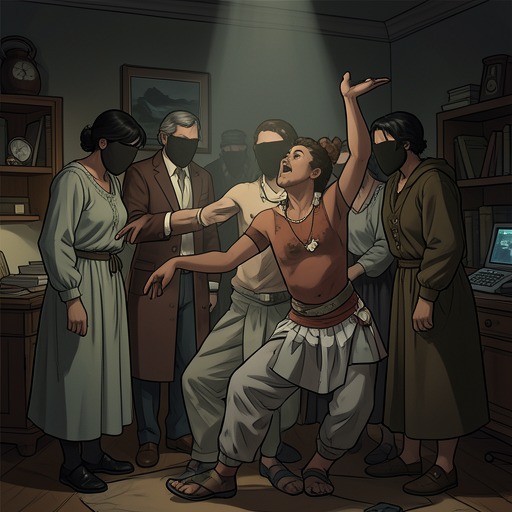
Brad Wolgast and Amy
The Passage (Justin Cronin Edition)Brad Wolgast and Amy’s relationship is a bond of protection that becomes unmistakably fatherly without depending on biological kinship. Its decisive turn comes when Wolgast tells Amy the intimate story of his dead daughter Eva and understands Amy’s arrival as a return of the love grief had seemed to extinguish; when he opens his eyes, Amy opens hers as well. Afterward, their life in an Oregon mountain lodge makes that emotional recognition practical, through shelter, food, reading, and careful attention to the limits imposed by Amy’s sensitivity to light.
Trust at the Moment of Surrender
At town hall, after Wolgast and his companions have surrendered their weapons, Wolgast kneels beside Amy and places his hands on her shoulders. He tells her to do whatever the man in charge instructs, explaining that he will be put in a cell and may not see her for some time. The instruction is protective, but it also acknowledges the painful separation he expects: he is preparing Amy for what will happen to him rather than promising that he can keep her beside him.
Amy answers that she wants to stay with him. The exchange makes the attachment reciprocal. Wolgast believes that surrender is the right thing because the Oklahoma state police will arrive and Amy will be safe, yet her tears and his own caught breath reveal the emotional cost of that decision. His care requires him to accept temporary confinement and place her safety in another person’s hands, even though Amy’s first choice is to remain with him.
That choice becomes concrete when Wolgast and Phil Doyle enter the town’s only cell. Amy asks to go into it too, and Wolgast agrees that she can wait with him. The cell is mostly occupied by cardboard boxes, but its smallness does not alter her decision: she would rather share his confinement than sit apart. In this brief reversal, Wolgast’s effort to protect her by surrendering gives way to Amy’s effort to preserve their closeness by following him inside.
A Fatherly Bond Made Public
The relationship is also named, in Amy’s own words, before anyone has explained it. While Wolgast and Doyle are detained, Amy sits at the reception desk with her backpack on her lap, eating an ice cream sandwich as a woman beside her shows her a coloring book. Amy tells the woman that Wolgast is her daddy. The woman looks from Amy to Wolgast in surprise, but the scene offers no correction or denial from him; he simply says that everything is all right.
Amy’s declaration makes explicit what the earlier exchange has already shown through action. She identifies Wolgast as a father, while he has taken responsibility for her safety and tries to prepare her for separation without hiding what is about to happen. The relationship is not established by formal adoption or a change in family status in these scenes. Instead, its meaning rests on their conduct: he safeguards her, and she seeks his presence even when that means joining him in a cell.
Eva, Grief, and Recognition
Later, Wolgast survives the first days and, on the third day, tells Amy the story he has told no one. He describes Eva as a little girl whose parents loved her, recalling how he held her bare against his own skin the night after she was born. In his telling, she was inside him from that moment onward, in his heart. This private account gives Amy access to the loss that has shaped his capacity for love.
Wolgast explains that Eva’s heart began to shrink while her body grew, and that her growth then stopped as well. He would have given her his heart, he tells Amy, because it had always belonged to her, but he could do nothing to save her. When Eva died, he says, he died with her: the man he had been was gone, and the love between him and Eva’s mother became inseparable from sadness and absence. The story is not merely a disclosure of bereavement; it tells Amy why Wolgast has understood himself as a person emptied by the death of his child.
As the story ends, Wolgast tells Amy that she came afterward and that finding her felt like Eva had come back to him. The thought does not erase the difference between Amy and Eva: rather, it lets Wolgast recognize in his care for Amy a return of the capacity for attachment that grief had made feel lost. He calls for Amy to come back, lifts his face, and opens his eyes. Amy opens hers too. The parallel gesture gives their bond a quiet, reciprocal culmination: after hearing the story Wolgast could not tell anyone else, Amy answers his awakening with her own.
Care in the Oregon Mountains
Their bond continues through the ordinary labor of keeping Amy safe. As she grows stronger, her sensitivity to light does not fade. Wolgast finds plywood, a ladder, a hammer, a saw, and nails in an outbuilding, then measures and cuts boards by hand and climbs to seal the lodge’s upstairs windows. The task is a practical response to Amy’s condition, and its importance lies in the adaptation it demands: the shelter must be changed around her needs.
Amy rests for much of the day and wakes at dusk to eat. Wolgast explains that they are in the mountains of Oregon, where he once went camping as a boy; she asks where they are, but not why. He cooks simple meals from the supplies on hand—canned soup and stew, crackers, and cereal softened with powdered milk—while the nearly full propane tank and drinkable, faintly sulfurous water make the lodge temporarily livable. He sees that the food will not last and that he will need to go down the mountain soon, a practical limit on the refuge he has made for her.
At night, under candlelight, Wolgast reads Amy books he has found in the basement: Treasure Island, Oliver Twist, and 20,000 Leagues Under the Sea. The reading belongs to the same pattern as boarding up the windows and making food. He offers company and stories within a routine organized around Amy’s rest and safety, turning the lodge into a place where their relationship can be lived day by day.
Protection and Its Limits
Amy sometimes comes outside during the day when clouds cover the sun. Wearing her glasses and cap, with a long towel tucked beneath the headband to cover her neck, she watches Wolgast cut wood, patch a hole beneath the eaves, or struggle to understand an old gasoline generator. These visits briefly bring her into the work and landscape around the lodge, but they cannot last: after about an hour her skin turns a vivid pink, and Wolgast sends her back upstairs.
The repeated return indoors shows both the reach and the limits of Wolgast’s protection. He can alter the building, provide food and water, read to Amy, and regulate her exposure; he cannot make her sensitivity disappear. Their closeness therefore takes shape not as a rescue completed once and for all, but as continuing attention to what her body can endure. Across the cell, the story of Eva, and the mountain lodge, Wolgast’s fatherly role is defined by the same choice: to stay responsible for Amy even when safety requires separation, adaptation, or the acceptance of what he cannot change.